If you haven’t read Part 1, the short version is this: “branching narrative” means different things to different people, and that ambiguity causes real problems when you’re trying to design, write, or budget a game. The goal of this series is to give you a shared vocabulary that actually holds up in a production meeting.
This is the field guide. Five structures, each with a name, a one-sentence explanation, and a real example you’ll recognize.
True Branching
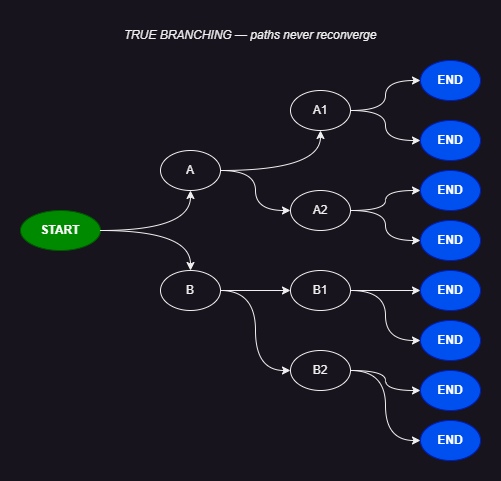
One sentence: The story splits at decision points and never reconverges — every choice leads to genuinely separate content all the way to the end.
This is what most people picture when they hear “branching narrative,” and it’s also the rarest structure in practice because it’s extraordinarily expensive to build. Every branch requires fully authored content — new scenes, new dialogue, new outcomes — and those branches can branch again, and those branches can branch again. The content requirement grows exponentially fast.
True branching exists in games like Planescape: Torment and some visual novels where wildly different playthroughs are the entire point. It’s also what gets promised in pitch documents far more often than it gets delivered, because nobody does the math on what it actually costs until it’s too late.
Branch and Bottleneck
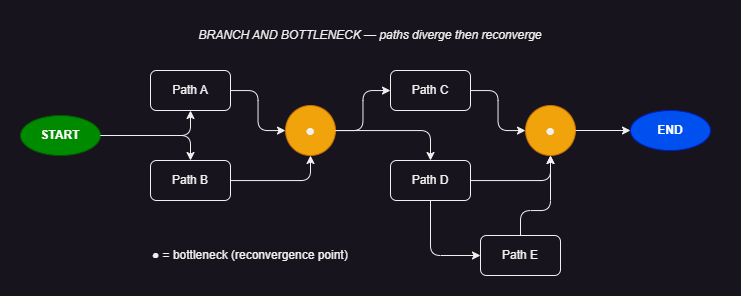
One sentence: The story splits into multiple paths that always converge back to a fixed point before splitting again.
This is probably the most common structure in narrative games, and it’s the one most often mislabeled as true branching. The player makes choices, follows different paths, has different experiences — and then everyone ends up in the same place before the next set of choices begins. The divergence is real. The reconvergence is also real.
Done well, this structure gives players a genuine sense of agency while keeping the story manageable to produce. Done poorly — when the bottleneck is too abrupt or too obvious — players feel the rails snap back into place and the illusion collapses. Most Telltale games, most BioWare RPGs, and a huge percentage of modern narrative games use this structure at their core.
Parallel Paths
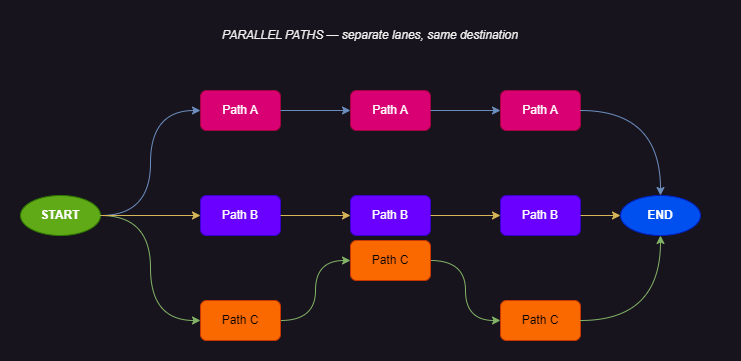
One sentence: The story offers multiple separate routes through the same overall narrative, covering similar beats from completely different angles.
Parallel paths are distinct from branch and bottleneck in one important way — the paths don’t necessarily reconverge at regular intervals. Instead, the player chooses a lane early and largely stays in it, experiencing the story from that particular angle. Different characters, different locations, different tones — but roughly the same story underneath.
Resident Evil 2’s Leon and Claire campaigns are a classic example. You’re playing through the same Raccoon City outbreak, but the experience is meaningfully different depending on who you chose. The paths cross occasionally but don’t collapse into one another — they run alongside each other all the way through.
Hub and Spoke
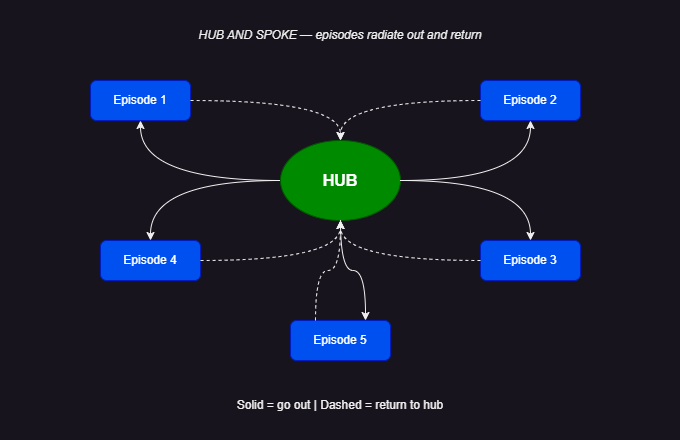
One sentence: A central story node anchors the narrative, and the player radiates out to self-contained episodes before returning to the hub each time.
If you’ve played a Telltale game, a classic LucasArts adventure, or almost any episodic narrative game, you’ve lived inside a hub and spoke structure. There’s a home base — a camp, a safehouse, a ship, a town — and from there the player ventures out into distinct story episodes. When the episode concludes, they return to the hub, which may have changed in response to what happened, before heading out again.
The hub does a lot of narrative work. It’s where characters reflect, relationships develop, and consequences of previous episodes accumulate. The spokes are where the action happens. Together they create a rhythm that can feel surprisingly expansive even when the actual authored content is relatively contained.
Gauntlet
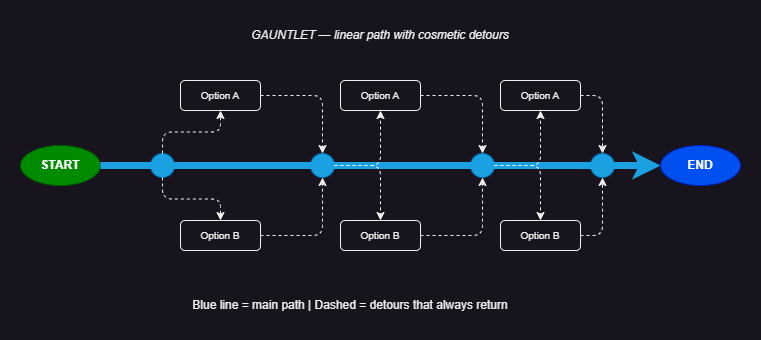
One sentence: The story is essentially linear, with small detours that always return to the main path almost immediately.
The gauntlet is the structure that gets called a branching narrative in the most pitch documents and delivers the least divergence in practice. That’s not necessarily a condemnation — a well-designed gauntlet can be an excellent game. The problem is when it’s sold as something it isn’t, because players and critics notice, and they will absolutely call it out.
The choices in a gauntlet are real in the sense that the player makes them, but they’re cosmetic in the sense that the story doesn’t meaningfully change. Almost any action game that added dialogue options in the last decade will give you a familiar example. You can tell the guard you bribed him or intimidated him, but either way the gate opens and you move on. The illusion of agency is the product. Sometimes that’s enough. Sometimes it isn’t. But it’s worth knowing that’s what you’re building.
So Which One Do You Actually Have?
Here’s the question worth asking at the start of every project, and honestly worth revisiting at every major milestone: which of these structures are you actually building?
Not which one sounds best in the pitch. Not which one the lead designer described in the kickoff meeting. Which one do you actually have, right now, based on the content that exists and the content you have the time and budget to build?
The answer to that question should drive a lot of decisions — how you write your dialogue, how you structure your quest design, how you set player expectations, and how you talk about the game publicly. Mislabeling your structure doesn’t just create confusion internally. It creates promises to players that the game may not be able to keep.
In Part 3 I’m going to talk about my own preferred approach — a structure that already has a name, but one I think does it a disservice. I’ll get into why I use it, when it works, and how the style and scale of a game should probably be influencing your structure choice more than it usually does.