A few months back I was given the opportunity to put together and present a talk to the whole studio about game audio. Keeping it under twenty minutes meant staying deliberately high level — which was harder than it sounds, because audio is one of those topics where every thread you pull leads to three more interesting threads underneath it. But the constraint turned out to be useful. Stripping it down to the essentials produced something that seemed to land, particularly one graphic that I kept coming back to throughout the talk.
That graphic is the spine of this post. Let’s get into it.
The Three Elements
Game audio is made up of a lot of moving parts, but at the highest level it can be broken down into three distinct elements, each doing a specific kind of work.
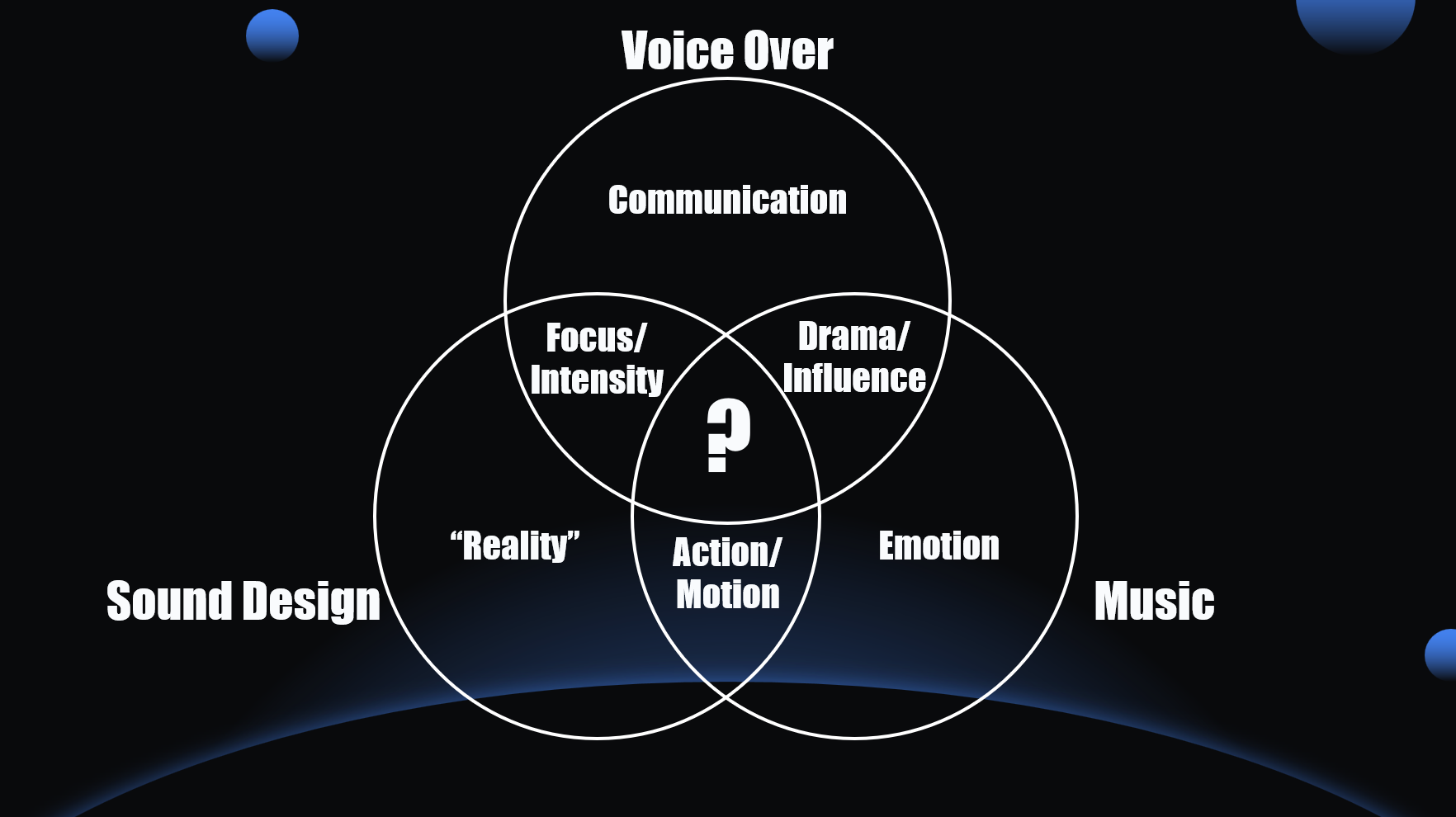
Voice Over — Communication
Voice over is the most direct tool in the audio toolkit. When it’s the primary focus of the soundscape — when everything else steps back to let it through — it’s the clearest and most efficient way to get information to a player. It communicates. It tells. It directs attention.
Music — Emotion
Music is shorthand for feeling. Happiness, sadness, dread, triumph — these all have recognizable sounds in the language of music, and a well-chosen piece of music can bridge the gap between what a game is trying to make a player feel and what they’re actually feeling in the moment. It doesn’t tell the player what to think. It suggests what to feel.
Sound Design — Reality
Sound design gives weight to things. It creates the space that everything else exists in. This doesn’t mean it has to reflect the real world — it means it reflects the reality of the world the player is in. A sword has a sound. A room has an acoustic signature. Footsteps on stone feel different from footsteps on grass. Sound design is what makes a world feel like it physically exists.
When You Combine Them
Here’s where it gets interesting. Each element does specific work on its own, but the combinations unlock different effects — and understanding those combinations is one of the most useful tools you can have when thinking about how audio is functioning in any given moment.
To illustrate each combination, let’s use a simple scene: a character standing at a doorway, hand on the handle, about to step through into something unknown. Same moment, same visual — but the audio tells a completely different story depending on what you use.
Voice Over + Music — Drama and Influence
In our scene, the character speaks. Maybe they’re steeling themselves, or saying something to someone behind them, or narrating a thought. And underneath that, music plays — something that colors the emotional temperature of the moment.
This combination is one of the most powerful tools for drama. The voice over carries the content of the moment, and the music tells the player how to feel about it without the character having to say it out loud. A line delivered over a swelling strings arrangement hits differently than the same line delivered over silence or tension. The music is doing influence work — gently shaping the player’s emotional response before they’ve consciously registered it. Used well, this combination can make a relatively simple moment feel genuinely cinematic.
Music + Sound Design — Action and Motion
Now there’s no voice. The character reaches for the handle. We hear the creak of the door, the ambient sound of whatever is on the other side beginning to bleed through — and underneath it all, music builds.
This combination is what carries scenes without dialogue. The sound design provides the physical reality of the moment — the texture, the weight, the sense that this door is real and opening it means something. The music provides the emotional momentum. Together they create motion — not just physical motion but narrative motion, the sense that something is happening and building toward something else. This is the combination you’ll find in most action sequences, exploration moments, and any scene that needs to breathe without anyone speaking.
Voice Over + Sound Design — Focus and Intensity
Back to our character at the door. They speak — but this time there’s no music. Just the voice and the physical reality of the space around them. The sound of their breathing. The creak of the building settling. The ambient noise bleeding under the door from whatever is on the other side.
Without music, something shifts. Music, as useful as it is, is also doing a kind of emotional labor on the player’s behalf — it’s telling them how to feel. Remove it and the player has to do more of that work themselves. The voice and the world it exists in become the whole story. Every physical sound carries more weight because there’s nothing softening the edges around it. If the character is speaking with fear in their voice, the silence where the music would have been makes that fear feel more exposed, more real.
This combination tends to work best in moments that need to feel unfiltered — confessions, confrontations, quiet decisions. Moments where the emotional truth of what’s being said shouldn’t be underlined, just heard.
The Question Mark
If you look at the graphic, there’s something in the middle where all three elements overlap. For a while I had the word “magic” in that space. It seemed right — all three elements working together should be the most powerful combination, the fullest expression of what game audio can do.
But that’s actually backwards.
In most cases, using all three elements simultaneously is overwhelming. At best it’s a lot. At worst it’s confusing — too much information competing for the player’s attention at once, none of it landing as clearly as it would if the soundscape had a little more space in it.
This isn’t just a game audio principle. Think about the most intense action sequences in any big budget film. If you track what’s happening in the audio moment to moment, you’ll almost never find a sustained mix of all three. The soundscape shifts dynamically — music drops out during a critical line of dialogue, sound design pulls back when the music needs to swell, voice over gets room when everything else needs to step aside. The orchestration of those shifts is where a lot of the craft lives.
In games it’s even more complex, because the player is generating chaos that the audio system has to respond to in real time. But the principle is the same: the question mark in the middle isn’t magic. It’s a warning. The most effective soundscapes aren’t the fullest ones — they’re the most intentional ones.
Why Any Of This Matters
You don’t need to be working in audio to find this framework useful. Next time you’re playing a game or watching a film, try tracking what’s in the soundscape moment to moment. Notice when music drops out and what that does to the tension. Notice when a scene has no voice over and how sound design fills that space. Notice the moments when all three are present and whether it works or whether it’s too much.
Once you start hearing it, you can’t really stop. And that’s a good thing — because understanding how audio is working on you is the first step toward understanding why some moments land and others don’t, even when everything else looks right.